Your submission was sent successfully! Close

Thank you for signing up for our newsletter!
In these regular emails you will find the latest updates from Canonical and upcoming events where you can meet our team.Close

Thank you for contacting us. A member of our team will be in touch shortly. Close

An error occurred while submitting your form. Please try again or file a bug report. Close

  1. Blog
  2. Article

Robin Winslow
on 31 May 2017

Our open source websites


Nowadays free software is everywhere – from browsers to encryption software to operating systems.

Even so, it is still relatively rare for the code behind websites and services to be opened up.

Stepping into the open

Three years ago we started to move our website projects to Github, and we also took this opportunity to start making them public. We started with the www.ubuntu.com codebase, and over the next couple of years almost all our team’s other sites have followed suit.
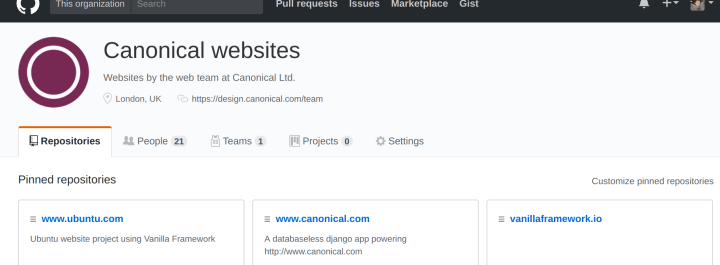
At this point practically all the web team’s sites are open source, and you can find the code for each site in our canonical-websites organisation.

www.ubuntu.com developer.ubuntu.com www.canonical.com
partners.ubuntu.com design.ubuntu.com maas.io
tour.ubuntu.com snapcraft.io build.snapcraft.io
cn.ubuntu.com jp.ubuntu.com conjure-up.io
docs.ubuntu.com tutorials.ubuntu.com cloud-init.io
assets.ubuntu.com manager.assets.ubuntu.com vanillaframework.io

We’ve tried to make it as easy as possible to get them up and running, with accurate and simple README files. Each of our projects can be run in much the same way, and should work the same across Linux and macOs systems. I’ll elaborate more on how we manage this in a future post.

We also have many supporting projects – Django modules, snap packages, Docker images etc. – which are all openly available in our canonical-webteam organisation.

Reaping the benefits

Opening up our sites in this way means that anyone can help out by making suggestions in issues or directly submitting fixes as pull requests. Both are hugely valuable to our team.

Another significant benefit of opening up our code is that it’s actually much easier to manage:

  • It’s trivial to connect third party services, like Travis, Waffle or Percy;
  • Similarly, our own systems – such as our Jenkins server – don’t need special permissions to access the code;
  • And we don’t need to worry about carefully managing user permissions for read access inside the organisation.

All of these tasks were previously surprisingly time-consuming.

Designing in the open

Shortly after we opened up the www.ubuntu.com codebase, the design team also started designing in the open, as Anthony Dillon recently explained.

Related posts


Miguel Divo
19 January 2026

Showcasing open design in action: Loughborough University design students explore open source projects

Design Article

Last year, we collaborated with two design student teams from Loughborough University in the UK. These students were challenged to work on open source project briefs. Team 1 focused on non-code contributions, while Team 2’s brief was to create a unified documentation experience, giving them a chance to apply their design skills to real-wo ...


Graham Morrison
18 December 2025

Design and Documentation clinics at FOSDEM Fringe 2026

Ubuntu Article

FOSDEM is one of the biggest and most exciting open source events of the year, held at the Solbosch campus of the Université Libre de Bruxelles (Brussels), Belgium. Thousands of open source contributors and enthusiasts attend, often with several folks from Canonical among them. The next one is coming quickly, with FOSDEM 2026 being held ...


Miguel Divo
21 November 2025

Open design: the opportunity design students didn’t know they were missing

Design Design

What if you could work on real-world projects, shape cutting-edge technology, collaborate with developers across the world, make a meaningful impact with your design skills, and grow your portfolio… all without applying for an internship or waiting for graduation? That’s what we aim to do with open design: an opportunity for universities ...